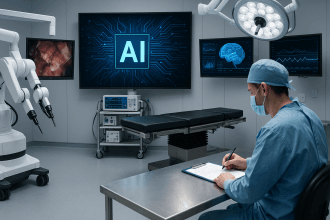




In a groundbreaking move, China’s AI platforms are reshaping surgery. They combine AI technology with clinical expertise. These platforms predict complications and enhance surgical precision. The goal is to build the “ultimate surgical brain” that improves patient outcomes and redefines surgery worldwide.
Background: AI’s Growing Role in Surgery
AI in healthcare is not new, but China’s pace is remarkable. The country has made huge investments in AI research. Billions of dollars have supported advancements in facial recognition and self-driving cars. Naturally, healthcare became a key area for development. In partnership with medical institutions, Chinese tech companies have developed AI systems to support surgical teams in the operating room (OR).
Key AI Innovations in Surgery
Tencent’s Miying is one such innovation. It predicts surgical complications, like bleeding, during complex operations. The system uses massive medical databases to apply machine learning. This allows it to detect patterns and risks that might be missed by human surgeons.
Another breakthrough comes from AI-driven robotic surgery systems. These robots use smart suturing to enhance precision. By analyzing real-time data, they reduce surgery time and speed up recovery. Studies published in The Lancet Digital Health report a 30% decrease in complications and faster recovery times for patients.
Dr. Li Wei, a leading surgeon at Tsinghua University, says, “AI tools give us insights and precision we didn’t have before. We can push the limits of patient care.”
Impact on the Healthcare Industry
The effects of AI surgery are profound. These systems not only improve surgical results but also address the shortage of skilled surgeons. AI offers decision support, which enhances human capabilities. It could make high-quality care more accessible, especially in under-resourced areas.
AI also promises major economic benefits. It can lower healthcare costs by reducing complications and shortening hospital stays. A McKinsey report predicts AI in surgery could save up to $40 billion annually by 2030.
Hospitals in cities like Shanghai and Beijing are already seeing these benefits. They report faster patient throughput and increased capacity to handle complex cases. This is transforming the healthcare ecosystem.
Looking Ahead: The Future of AI in Surgery
As AI in surgery continues to evolve, the focus will shift toward personalization. Future AI systems will customize surgical plans based on individual patient data. This will further optimize outcomes.
China’s journey to create the “ultimate surgical brain” is only just beginning. The future promises safer, faster, and more efficient surgeries. While challenges remain—such as data privacy and broader clinical integration—the potential for AI to revolutionize surgery is clear.
Conclusion
In conclusion, China’s AI surgery revolution is reshaping the way we think about surgery. With its ability to predict complications and improve precision, AI is opening new possibilities in patient care. As these technologies grow, they will continue to transform global healthcare.