


[SECTION 01 // THE LOGISTICS CRISIS]
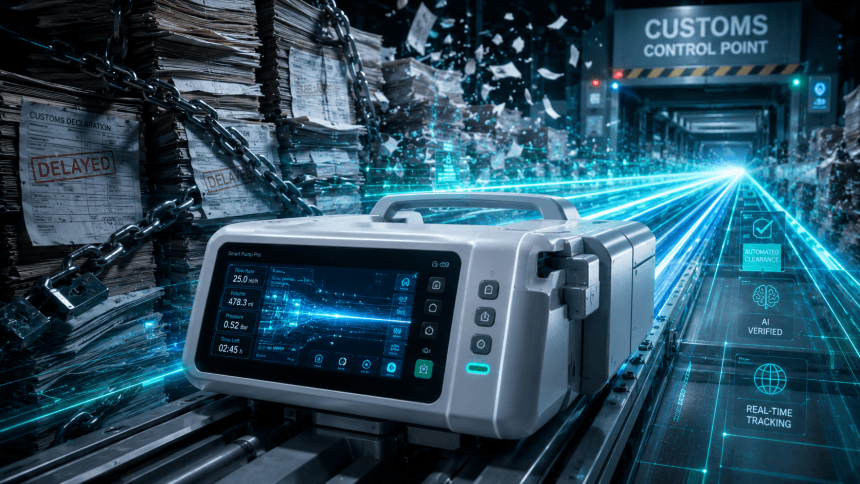
Traditional medical logistics is dead. I believe that old setup is far too slow.
Therefore, recent market shifts and tight budgets proved this old plan is weak. Thus, the lack of speed showed a harsh reality. From my point of view, slow customs clearing costs too much. This high administrative price is a dangerous barrier.
💡 [Core Takeaway] Legacy administrative friction directly blocks critical clinical deployment at smaller frontline hospitals.
Instead, this delay blocks the growth of smaller hospitals. On the contrary, frontline doctors face a real limit. Fewer patients get critical medical devices on time.
Consequently, I see a rapid shift toward smart systems in global health. Global innovation breaks the barriers of slow supply chains.
[SECTION 02 // THE COMPLIANCE BOTTLENECK]
We must stop looking at numbers on paper. But, it is better to look at the real floor of the clinic. Importing advanced medical pumps before promised local care fast.
However, that old choice brought very long wait times at the border. The delay lasted for several weeks.
💡 [Core Takeaway] Slow, manual data validation loops break down entirely during regional public health emergencies.
Therefore, the old system fails when a regional health crisis hits. Hospitals need dynamic hardware right away. For example, ICU device delivery demands total speed. Furthermore, if the internal data check fails, the entire care chain breaks.
And I believe that moving audits to a cloud matrix eliminates massive storage spending. It also removes human errors in the process. Consequently, this vital shift requires hyper-automation software, not more manual checks. Global innovation makes the current clearing line infinitely faster through automated code.
[SECTION 03 // GREEN LANE INFRASTRUCTURE]
In this new configuration, delivery speed depends on digital connection. I am sure of this. Therefore, procurement teams no longer believe in distant promises.
Thus, I see that smart health networks choose very short clearing lanes. They want to have their tracking tools inside a shared cloud.
💡 [Core Takeaway] Cloud-native supply frameworks are rapidly expanding, driving legacy distributors out of the B2B market.
As a result, old-school manual vendors are losing ground fast. Furthermore, elite biomedical brands with integrated automated services take control of the market. This specific pain point is where leading innovators must step in today.
In recent supply audits, specialized transport networks using cloud-based automation tools won the game. They set the new superior standard of global innovation. Specifically, these leading partners ensure that device customs papers are ready now. Experts configure these files in just a few hours.
Because this local setup bypasses the limits of old paperwork, hospitals win. Therefore, they keep their clinical supply lines open without stopping.
[SECTION 04 // DATA FLOW & ISO STANDARDS]
The true engine for fast delivery is not just a fast truck. In my view, it is the fast speed of encrypted data. Because crossing borders without stops requires clear paperwork.
For example, sending high-resolution device logs to remote inspectors requires clean data compliance. Furthermore, medical distribution groups win a huge prize here.
💡 [Core Takeaway] Partnering with international providers who manage direct ISO file oversight completely eliminates border seizure risks.
They win when they choose authorized international hardware providers who maintain direct oversight of ISO compliance files. This changes the business completely.
Then, by ensuring that every digital file fits global safety rules, networks win speed. These specialized clearing networks help pass global audits very fast. Consequently, this clear compliance protects hospitals from dangerous device delays. It also stops the slow processing of critical patient files.
[SECTION 05 // THE DIGITAL SHIELD]
In the end, the changing market gives us all a sharp warning. Modern medicine is only as strong as its digital infrastructure. People debate purchase prices all day.
However, my vision remains the same. The daily defense of human health relies on smart data innovation. There is no other option in the current market.
💡 [Core Takeaway] Clinical resilience is no longer about local inventory; it is completely tethered to cloud-native logistics.
In the future, I predict that winning the battle against supply shortages will depend on automated clouds. Aesthetically and technically competent medical distributors keep building this solid foundation.
They build the invisible shield for modern healthcare. Furthermore, this framework allows frontline clinicians to have accurate tools right when they need them. For more deep insights on global medical networks, follow the news on Mediscope.