



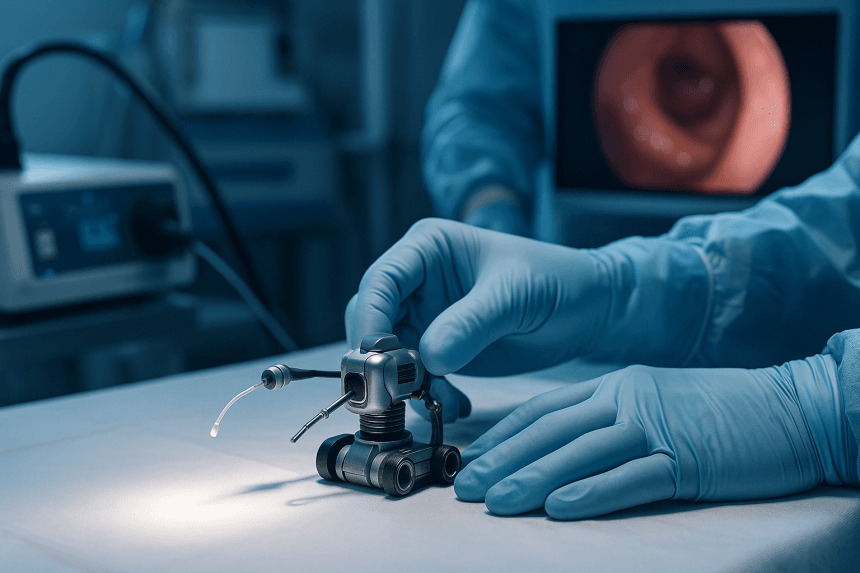
Colorectal Cancer Robot: UK Mini Device Transforms Cancer Detection and Treatment
UK scientists have developed a Colorectal Cancer Robot that can detect and treat colorectal cancer in a single, integrated procedure. Announced at the International Conference on Robotics and Automation, this mini robotic medical device promises to revolutionize how clinicians diagnose and manage one of the most common cancers worldwide.
Colorectal cancer ranks as the third most prevalent cancer globally, with over 1.9 million new cases diagnosed annually, according to the World Health Organization. Traditional methods, such as colonoscopies, though effective, can be uncomfortable and are usually followed by separate treatment sessions if cancer is found. The UK-developed robot aims to streamline this process, offering a less invasive and more efficient approach for patients and healthcare providers.
Cutting-Edge Robotic Development
The project is a collaboration between the University of Leeds and leading UK medical technology firms, designed to enhance early detection and treatment precision. Dr. Sarah Thompson, lead researcher at the University of Leeds, explains, “By combining diagnostics and treatment in a single device, we aim to reduce the time between detection and intervention, improving both clinical efficiency and patient outcomes.”
The robot, no larger than a standard pill, integrates high-definition imaging with precision instruments to identify cancerous tissues and deliver targeted treatment. Utilizing micro-ultrasound robot technology and laser ablation treatment, it provides non-invasive, real-time assessments that differentiate between benign and malignant tissues, selectively treating cancer cells.
Enhancing Clinical Efficiency
Early detection is vital to improving survival rates in colorectal cancer. This integrated diagnostic-treatment device offers a streamlined workflow, reducing patient anxiety and hospital visits. Its compact design allows smooth navigation through the colon, minimizing discomfort compared to conventional colonoscopies.
Dr. James Bradley, an oncologist familiar with the technology, comments, “This device could redefine minimally invasive cancer care. Its ability to detect and treat early-stage cancer efficiently sets a new standard for patient-friendly procedures.
Looking Ahead
Preliminary tests have shown promising outcomes, with broader clinical trials planned to evaluate safety and effectiveness across diverse patient populations. If successful, regulatory approval could be sought within two years, followed by wider clinical adoption. The device also holds potential economic benefits by reducing multiple procedures and hospital stays, easing the strain on healthcare systems.
Future Implications
The success of this innovative cancer technology could extend beyond colorectal cancer. Its modular design allows adaptation for other conditions where early intervention is critical, suggesting a future of versatile UK medical robotics and integrated diagnostic-treatment solutions.
In conclusion, the Colorectal Cancer Robot marks a significant step forward in minimally invasive cancer care. As further trials progress, the global medical community anticipates a future where patients experience faster, safer, and more efficient cancer diagnosis and treatment, improving survival rates and quality of life worldwide.