


The traditional Pharma R&D workflow—often characterized by “Eroom’s Law” (the observation that drug discovery becomes slower and more expensive over time despite technological advancements)—suffers from escalating costs and diminishing returns. Historically, bringing a single new molecular entity (NME) to market requires a grueling 10–15 years and capital investments exceeding $2.6 billion, with overall failure rates hovering around 90%. This high-stakes, trial-and-error paradigm has created a costly “valley of death” that severely bottlenecks pharmaceutical innovation, particularly as the industry attempts to shift from broad “blockbuster” drugs to highly targeted precision medicines.
Artificial Intelligence (AI) is actively reshaping this landscape. By synthesizing vast biophysical and chemical datasets, AI is transitioning drug development from an empirical, high-risk numbers game into a predictive, data-driven science. Instead of discovering failure in late-stage clinical trials, AI allows researchers to “fail fast and fail cheap” in a computational environment—fundamentally altering the cost-and-efficiency curves of modern medicine.
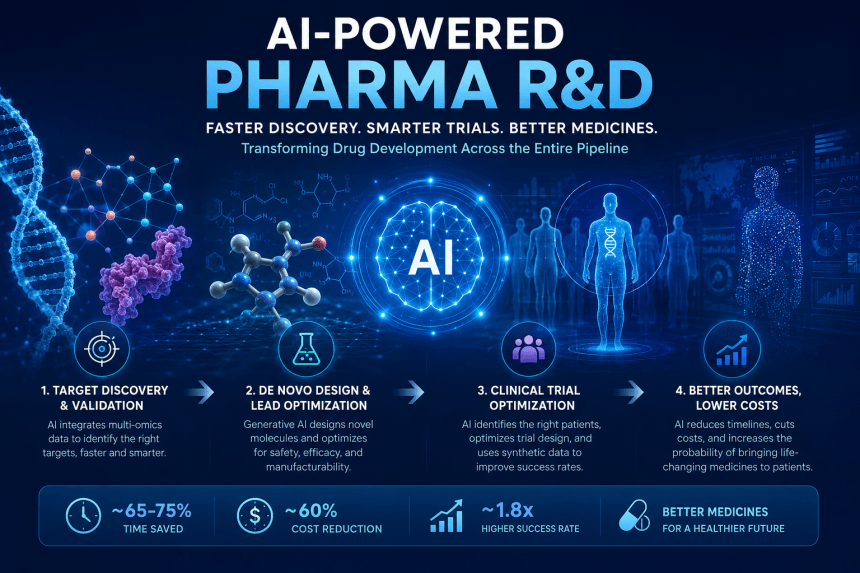
1. Target Discovery & Validation in Pharma R&D
Historically, identifying biologically relevant targets (such as disease-causing proteins, genes, or RNA sequences) required years of painstaking wet-lab labor. Researchers relied heavily on manual gene-knockout studies, animal models, and cellular assays, which were inherently constrained by human cognitive bandwidth and single-variable testing. Because many complex diseases like Alzheimer’s or solid tumors are systemic and polygenic rather than driven by a single faulty gene, this reductionist approach often led to targets that looked promising in a petri dish but failed entirely in human physiology. Today, advanced AI models trained on multi-omics data are mapping the interconnected architecture of human disease, identifying complex signatures in a matter of weeks or months.
Core Argument: AI accelerates target identification by distilling massive, heterogeneous multi-omics datasets into precise biological hypotheses, dramatically reducing early-stage discovery timelines and mitigating the biological risk that causes Phase II efficacy failures.
- Multi-Omics Integration & Network Pharmacology: Deep learning architectures, particularly Graph Neural Networks (GNNs) and Autoencoders, transcend traditional single-omics siloing by aggregating million-sample clinical datasets (encompassing genomics, proteomics, transcriptomics, and epigenomics). By treating biological systems as complex networks, these algorithms can discover subtle disease drivers, hidden feedback loops, and alternative signaling pathways that human researchers would inevitably overlook. This allows for the identification of “synthetic lethality” in cancer or compensatory pathways that might cause drug resistance down the line.
- 3D Structural Prediction & Dynamic Modeling: Next-generation structural biology models like AlphaFold3 and ESMFold have shifted the paradigm from simple structure prediction to complex biomolecular interaction modeling. Previously, characterizing a protein’s structure required years of expensive X-ray crystallography or cryo-EM experiments. Now, researchers can accurately predict protein 3D structures, including complex protein-ligand and protein-nucleic acid interactions, in seconds. Crucially, newer AI models are beginning to predict conformational flexibility—how a protein moves and changes shape—unveiling novel, transient “druggable pockets” on targets previously deemed “undruggable.”
2. De Novo Molecular Design & Lead Optimization
Once a biologically relevant target is validated, the primary hurdle is navigating an astronomically vast chemical space, estimated at 10 to the 60th power potential small molecules. Traditional High-Throughput Screening (HTS) acts like searching for a needle in a haystack, testing millions of existing compounds in physical libraries with the hope of finding a weak match. Generative AI models (including Diffusion Models, Generative Adversarial Networks, and Transformer-based chemical language models) enable true De Novo Molecular Generation. They learn the “grammar” of chemistry to design entirely novel, tailor-made compounds strictly to targeted biological specifications, bypassing the limitations of legacy chemical libraries entirely.
Core Argument: Generative AI shifts molecule discovery from brute-force screening to targeted algorithmic creation, expanding usable chemical space while simultaneously co-optimizing safety, efficacy, and manufacturability from day one.
- Breaking the “Trade-Off Wall” via Multi-Property Optimization: Traditional lead optimization is heavily iterative and fraught with compromises; for example, tweaking a molecule to increase its target potency often inadvertently increases its liver toxicity or reduces its water solubility. AI algorithms utilize multi-objective reinforcement learning to co-optimize key parameters in real time. They simultaneously balance binding affinity, metabolic stability, blood-brain barrier permeability, and complex ADMET (Absorption, Distribution, Metabolism, Excretion, and Toxicity) profiles, generating “Goldilocks” molecules that meet all criteria at once.
- Virtual Screening & AI-Driven Retrosynthesis: Deep-learning scoring functions evaluate billions of virtual compounds in a matter of hours, filtering out unstable, toxic, or highly reactive candidates well before any physical synthesis occurs. However, a computationally perfect molecule is useless if it cannot be synthesized. Concurrently, AI-driven retrosynthesis tools map out the most efficient, cost-effective chemical synthesis pathways. By predicting chemical reactions and identifying commercially available precursor materials, AI ensures that theoretically ideal molecules are actually manufacturable in a laboratory setting.
3. Clinical Trial Optimization & Patient Stratification
The steepest financial losses in Pharma R&D occur during Phase II and Phase III clinical trials, which routinely account for over 60% of total drug development budgets. High attrition rates at this stage rarely stem from total drug inactivity; rather, they are the result of poor trial design, patient heterogeneity (“testing an effective drug on the wrong subgroup of patients”), or unexpected adverse effects. AI is mitigating these systemic downstream risks through predictive trial architecture, precise patient selection, and novel data simulation techniques.
Core Argument: Machine learning minimizes the single largest pharmaceutical expense—clinical trial failure—by utilizing predictive biomarkers to match candidate drugs with precisely targeted patient sub-cohorts, maximizing the statistical probability of clinical success.
- Smart Biomarker Identification & Patient Stratification: Traditional “one-size-fits-all” trial recruitment often dilutes therapeutic signals because a drug may only work for a specific genetic subset of a disease population. Natural Language Processing (NLP) and machine learning models analyze vast troves of unstructured pre-clinical data, Real-World Evidence (RWE), and Electronic Health Records (EHRs) to identify specific genomic, phenotypic, or clinical sub-profiles most likely to demonstrate a positive response. This precision stratification vastly increases the statistical power of clinical trials, allowing for smaller, faster, and more decisive studies.
- Synthetic Control Arms (SCAs) & Digital Twins: Recruiting patients for control groups is notoriously slow, expensive, and in cases involving severe oncology or rare diseases, highly unethical (as it requires giving patients a placebo). By leveraging massive historical trial databases and longitudinal patient health data, AI can generate Synthetic Control Arms and “Digital Twins” of patients. These algorithms accurately simulate how a specific patient profile would progress on standard-of-care treatments, reducing the number of human participants required for traditional control groups, accelerating recruitment timelines, and drastically cutting operational overhead.
4. Quantitative Benchmark: Traditional vs. AI-Enabled Pharma R&D
The metrics clearly demonstrate how AI operates as a force multiplier across time, cost, and risk vectors when integrated into early- and mid-stage drug development workflows:
| Development Metric | Traditional R&D Benchmark | AI-Empowered Benchmark | Estimated Efficiency Gain |
| Target-to-Hit Timeline | 24 – 36 months | 6 – 12 months | 65–75% Time Saved |
| Lead Optimization Cost | $10M – $20M per program | $3M – $7M per program | 60% Cost Reduction |
| Phase I Transition Rate | 40–50% success rate | 80–90% success rate | 1.8x Improvement |
| Average Early-Phase Cost | $1.0 Billion | $350 – $450 Million | 55–65% Cost Reduction |