



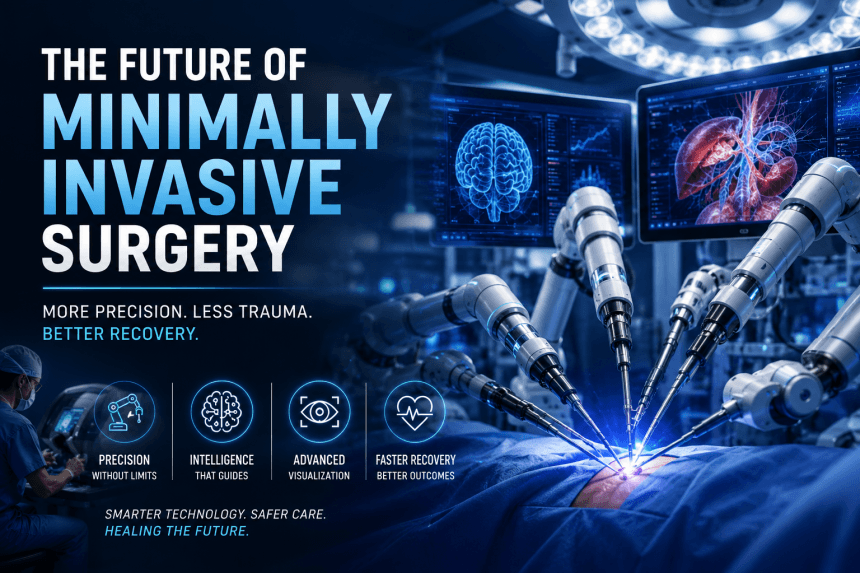
Minimally Invasive Surgery changes modern medicine. This shift moves us from open trauma to tiny cuts. Medical tools have grown fast. They now form smart, data-driven systems. Because of this, patient safety reaches new heights.
Part 1: Surpassing Human Limits: The Robotic Precision Revolution
Core Argument: The Integration of Robotic-Assisted Systems is Redefining Surgical Precision and Human Limitations
Robotic systems go beyond human hands. These smart tools stop shaky movements. They turn big hand motions into tiny tweaks. Doctors use them to reach tight spaces. Thus, tissue work is very exact. Special seats cut down on doctor tiredness. In the end, robot tools lower blood loss.
Part 2: The Intelligent Co-Pilot: AI and Predictive Analytics in the OR
Core Argument: Artificial Intelligence and Real-Time Analytics Are Transforming the Operating Room into a Smart Environment
AI turns the operating room into a smart digital space. Before surgery starts, AI tools read scans to build 3D maps. Teams test hard operations first. While working, smart vision tools point out key parts. Doctors stop nerve harm safely. Computer tools also guess bad post-surgery issues.
Part 3: Seeing Beyond the Surface: Advanced Visualization and Accelerated Recovery
Core Argument: Advanced Visualization and Hyper-Minimally Invasive Techniques Are Accelerating Post-Operative Recovery
New screens give clear views inside the body. Special light scans check blood flow well. Tiny cut methods lower body stress. Single-port tools cut down post-surgery pain. Because of this, sick people stay in beds for less time. They go back to normal life fast.
Traditional Open Surgery vs. Next-Generation Minimally Invasive Surgery
| Comparison Metric | Traditional Open Surgery | Next-Generation Minimally Invasive Surgery |
|---|---|---|
| Incision Size | Large, wide cuts (10 to 20+ cm) | Tiny cuts or needle size (0.5 to 1.5 cm) |
| Visualization | Direct naked-eye view | 4K/3D high-definition and smart AR views |
| Precision & Control | Tied only to human hands | Robot help that stops shakes and scales moves |
| Intraoperative Blood Loss | Usually higher | Much lower |
| Hospital Stay Duration | Long recovery (1 to 2+ weeks) | Fast leaving (1 to 3 days) |
| Post-Operative Complications | Higher risk of infection | Lower risk and tiny scars |
Conclusion
Surgery has moved past old limits. Robot accuracy, smart AI, and clear views bring safer care. As these tools grow, future surgery promises quicker healing for all.