



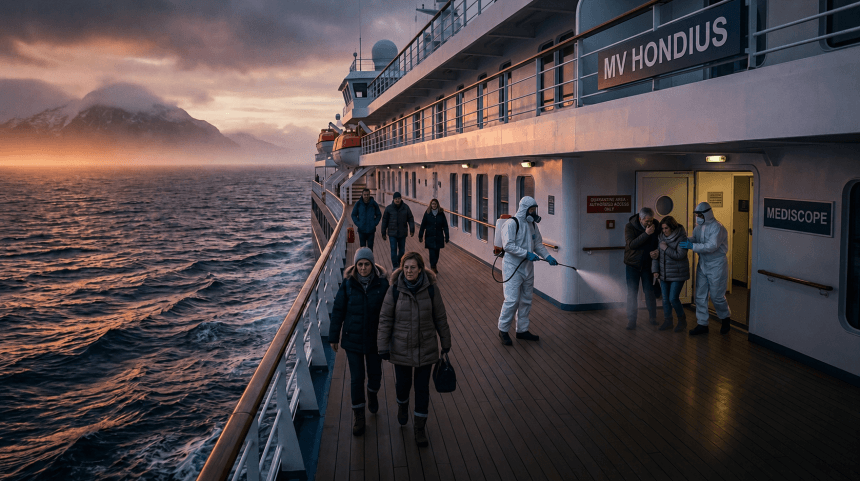
The port of Ushuaia sits at the jagged tip of Argentina, prepared to welcome the Victoria as she emerged from the dawn mists. However, the atmosphere shifted when the first encrypted medical bulletins reached the World Health Organization regarding a confirmed Andes virus outbreak. Consequently, the luxury liner—once an icon of elegance—transformed into a solitary, crimson dot of contagion on the maritime map as the Andes virus forced the vessel into an immediate and harrowing quarantine.
The Origin of a Silent Threat
Specifically, stories like this often begin with the utterly mundane. For instance, a traveler might disturb a long-tailed pygmy rice rat during a trek through the South American scrub. Alternatively, a tiny creature carrying a stowaway pathogen could slip into a cargo crate destined for the ship’s larder. In our comfortable world, no one connects fragile forest life with the specter of death. Nevertheless, this is the terrifying hallmark of the Andes virus (ANDV). It acts as a “lurker” of immense patience.
A Chilling Evolutionary Leap
In the vast evolutionary tree of hantaviruses, the Andes virus stands as a chilling outlier. It has acquired a skill that rewrites the rules of engagement. Furthermore, it possesses the rare ability for human-to-human transmission. Most of its cousins stay trapped within a “spillover” logic. They require rodent waste to infect a human and usually die out with that host.
By contrast, the Andes virus has found a more efficient highway. It no longer needs the rat in the confined, social corridors of a cruise ship. Instead, it moves through breath and touch. Initially, the signs are deceptive, appearing as chills and a rising fever. Yet, this is merely the preamble to a systemic collapse. Within hours, the lungs’ capillaries fail like breached levees. Consequently, plasma floods the bronchial tubes.
Drowning on Dry Land
Medicine uses a hauntingly vivid term for this: “Drowning on dry land.” Because the mortality rate nears 40%, Hantavirus Pulmonary Syndrome (HPS) leaves the healthcare system with almost no time to react. This brutal efficiency forces us to stop and reflect.
Indeed, we often view nature through the lens of conquest. We build extravagant liners to reach the most pristine wilderness. However, the helical structure of the Andes virus scrutinizes this blind arrogance. It did not evolve to destroy civilization. Instead, it existed in a state of ancient equilibrium until our footsteps crushed the boundary between us.
The Price of Global Connectivity
The cost of this trespassing magnified on the deck of the ship. We use sophisticated algorithms to optimize our trade routes. Nevertheless, we remain helpless against a single micron-sized droplet drifting through a gala dinner. We believe steel and glass shelter us. In truth, we stand as naked before a primitive microbe as our ancestors did.
Currently, the Victoria remains in international waters. Onshore, quarantine lights burn late into the night. Meanwhile, scientists scramble to strip away the genetic code of the Andes virus. The news cycle will eventually stabilize, and the ship will eventually dock. But the story does not end there.
Ultimately, a question lingers like the North Atlantic fog. As we force open nature’s closed doors, are we becoming more powerful, or simply more exposed? The surface of the sea always returns to a deceptive calm after a storm. However, the undercurrents never cease. We are all passengers on this vessel called Globalization, and none of us have found a way to disembark.